
Working with massive information units is all the time tough. Excel is without doubt one of the strongest instruments you should utilize to control, format, and analyze massive units of knowledge.

A number of well-known capabilities exist that will help you search for particular matches inside a dataset, like VLookup.
However capabilities like VLookup had sure limitations, so Microsoft not too long ago launched the XLookup operate to Excel. It gives a extra sturdy technique for locating particular values in an information set.
Understanding how you can use it successfully can drastically reduce down the time you spend making an attempt to investigate information in Excel.
What does XLookup do in Excel?
The Advantages of XLookup in Excel
XLookup Required Arguments
XLookup Non-compulsory Arguments
Learn how to Use XLookup in Excel
Finest Practices for XLookup in Excel
![Download 10 Excel Templates for Marketers [Free Kit]](https://no-cache.hubspot.com/cta/default/53/9ff7a4fe-5293-496c-acca-566bc6e73f42.png)
What does XLookup do in Excel?
The core performance of the XLookup is the power to seek for particular values in a spread or array of knowledge. Whenever you run the operate, a corresponding worth is returned from one other vary or array.
In the end, it’s a search instrument to your Excel datasets.
Relying in your arguments, XLookup will present you the primary or final worth in situations with a couple of matching consequence.
Different lookup capabilities like VLookup (vertical lookup) or HLookup (horizontal lookup) have limitations, corresponding to solely looking out from proper to left. Customers have to both rearrange information or discover complicated workarounds to mitigate this.
XLookup is a much more versatile resolution, permitting you to get partial matches, use a couple of search standards and use nested queries.
Try this XLookup Excel tutorial to see it in motion:
The Advantages of XLookup in Excel
The primary good thing about XLookup in Excel is the time financial savings it gives. You possibly can obtain the search consequence with out manipulating information positioning, for instance.
Like different Excel lookup formulation, it saves an enormous period of time that might in any other case must be spent manually scrolling via rows and rows of knowledge.
In the case of comparisons with different lookup capabilities, XLookup’s flexibility is vital. For instance, you should utilize wildcard characters to seek for partial matches.
This helps to scale back errors total, as you should utilize it to search out information which may be misspelled or entered incorrectly.
The arguments for XLookup are additionally less complicated than VLookup, making it quicker and simpler to make use of. XLookup defaults to a precise match, for instance, whereas you would need to specify this in your VLookup argument.
The general performance of XLookup is superior since it might probably return a number of outcomes directly. One instance of this use case can be trying to find the highest 5 values in a specific dataset.
XLookup Required Arguments
Your XLookup operate requires three arguments:
- Lookup_value: That is the worth you’re trying to find in an array.
- Lookup_array: That is the vary of cells the place you need the return worth to be displayed.
- Return_array: That is the vary of cells the place you need the operate to seek for the worth.
So a easy model of an XLookup would appear to be this:
=XLOOKUP(lookup_value, lookup_array, return_array)
XLookup Non-compulsory Arguments
The XLookup operate additionally has a number of elective arguments that you should utilize for extra complicated situations or to slender down your search:
- Match_mode: This determines the kind of match to make use of, corresponding to actual match or wildcard match to get partial matches.
- Search_mode: This determines whether or not your operate ought to search from left to proper or vice versa.
- If_not_found: This argument tells the operate what worth ought to be returned if there isn’t a match in any respect.
With elective arguments included, the XLookup operate seems like this:
=XLOOKUP(lookup_value, lookup_array, return_array, [if_not_found], [match_mode], [search_mode])
Learn how to Use XLookup in Excel
1. Open the Excel and the datasheet on which you need to use the XLookup operate.
2. Choose the cell the place you need to place the XLookup Excel system.
3. Sort “=” into that cell after which kind “XLookup.” Click on on the “XLookup” possibility that comes up within the dropdown.
.jpg?width=1999&height=1182&name=xlookup-1%20(1).jpg)
4. A gap parenthesis will mechanically generate. After the opening bracket, enter the required arguments within the right order: lookup_value, lookup_array, and return_array.
This implies choosing the vary of cells for every argument and inserting a comma earlier than shifting on to the following argument.
.jpg?width=1999&height=1190&name=xlookup-2%20(1).jpg)
5. In case you’re utilizing any elective arguments, enter them after the required arguments.
6. When your XLookup arguments are full, add a closing parenthesis earlier than hitting enter.
7. The outcomes of your XLookup ought to be displayed within the cell the place you entered the operate.
.jpg?width=1999&height=1185&name=xlookup-3%20(1).jpg) On this Excel XLookup instance, we used XLookup to search out out the grade for a specific scholar. So, the lookup_value was the scholar’s title (“Ruben Pugh”).
On this Excel XLookup instance, we used XLookup to search out out the grade for a specific scholar. So, the lookup_value was the scholar’s title (“Ruben Pugh”).
The lookup_array was the record of scholar names beneath column A. Lastly, the lookup_return was the record of scholar grades beneath column C. With that system, the operate returned the worth of the scholar’s grade: C-.
However how do you utilize XLookup with the elective arguments?
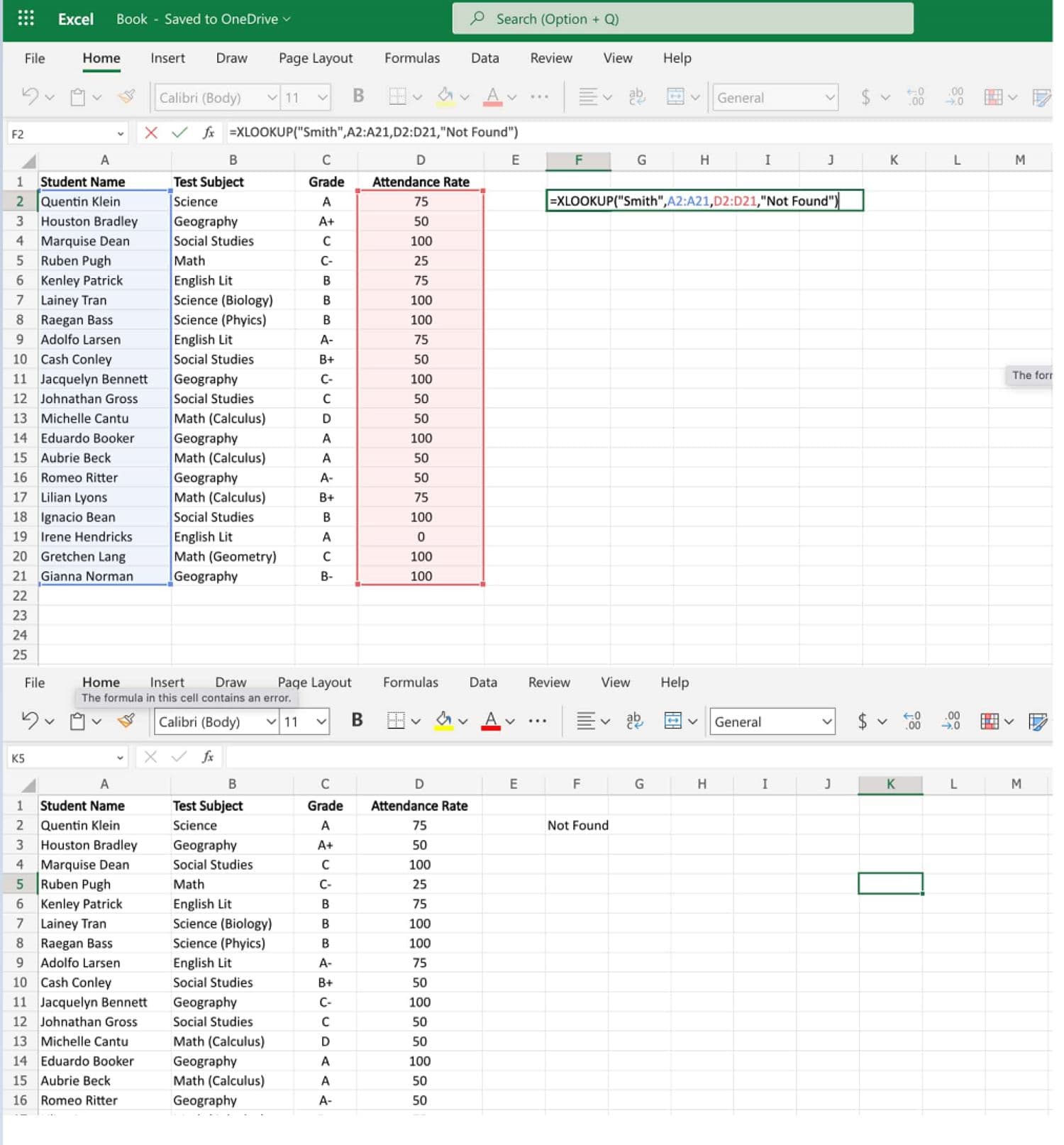
Utilizing the identical information set as above, let’s say we need to discover the attendance charge for a scholar with the surname “Smith.”
Right here, we’re telling Excel to return the message “Not Discovered” if it can not retrieve the worth, indicating that the scholar “Smith” is just not on this record:
 Now, let’s say we need to decide whether or not any college students had an attendance charge of 70%. However we additionally need to know the following closest attendance charge if 70% doesn’t exist within the dataset.
We’ll use the worth “1” beneath the match_mode argument to search out the following largest merchandise if 70 doesn’t exist:
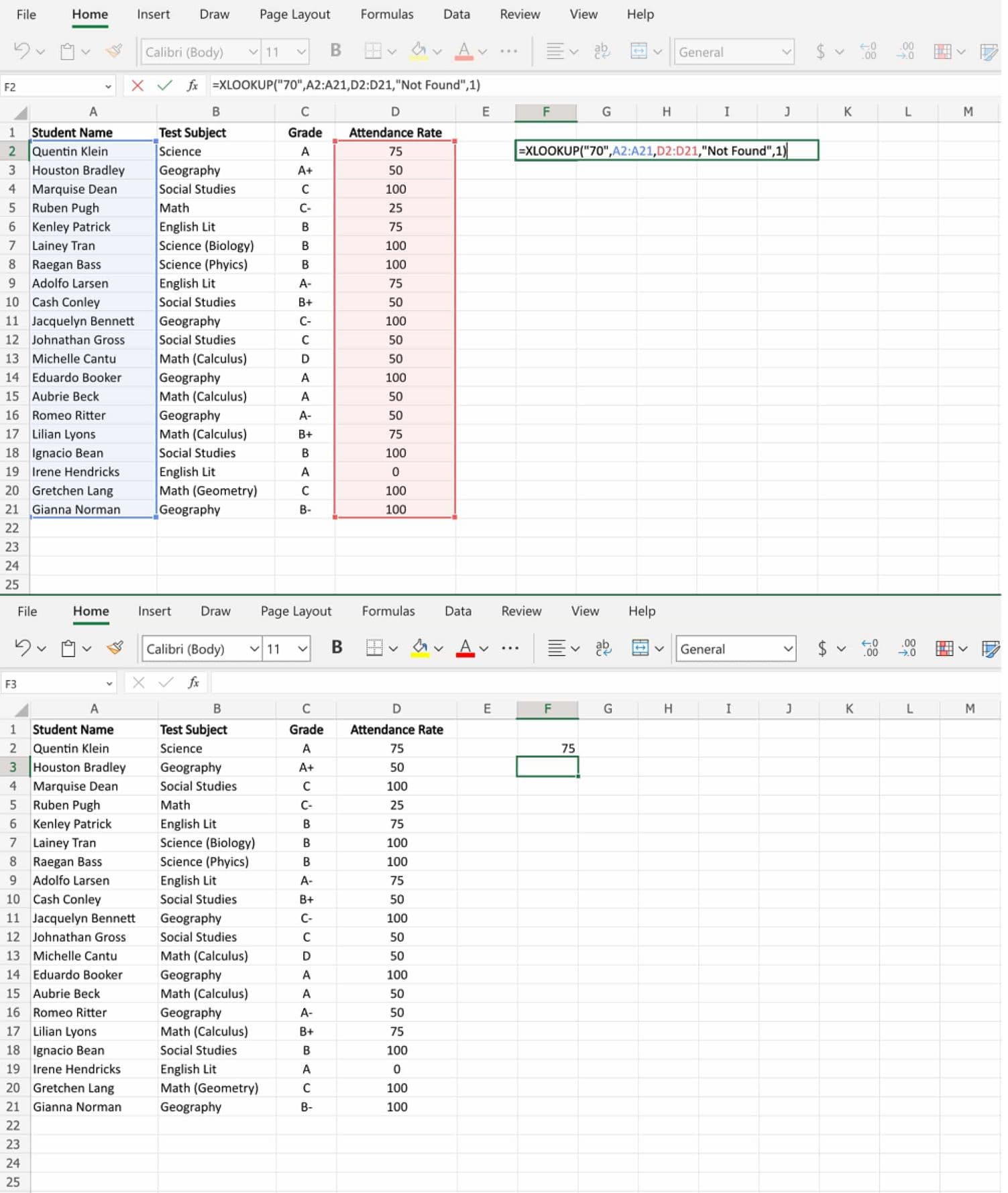 Since no scholar has a 70% attendance charge, the XLookup has returned “75,” the following largest worth.
Finest Practices for XLookup in Excel
Use Descriptive References
It’s preferable to make use of descriptive references for the cells you’re utilizing somewhat than generic ranges like A1:A12.
When it comes time to regulate your system (which you are inclined to do regularly with a operate like XLookup), descriptive references make it simpler to grasp what you had been initially utilizing the system to do.
That is additionally helpful for those who go the spreadsheet off to a brand new person who wants to grasp the system references rapidly.
Use Precise Match The place Doable
Utilizing the precise match default inside the system (versus wildcard characters) helps make sure you don’t get unintended values within the return.
Wildcard characters are extra helpful for figuring out partial matches, however the actual match is one of the simplest ways to make sure the system works as supposed.
Hold Argument Ranges the Similar Measurement
When placing your arguments collectively, just be sure you use the identical variety of cells for the return_array and the look_up array. If not, you’ll get an error, and Excel will solely return #VALUE within the cell.
Take a look at Your Components
It’s not tough to repair issues with a easy XLookup. However for those who’re utilizing nested capabilities or XLookup at the side of different formulation, make sure you’re testing every little thing alongside the way in which.
In case you don’t and obtain an error, it may be difficult to work backward and determine the place the operate goes unsuitable.
Getting Began
As a brand new and improved manner to make use of lookup performance in Excel, the XLookup outperforms the traditional VLookup in a number of methods.
Whereas the fundamentals of the operate are simple to know, it might probably take some apply to make use of XLookup in additional complicated methods. However with some apply information and check situations to work on, you’ll grasp the XLookup very quickly.

from Digital Marketing – My Blog https://ift.tt/n7q3p1a
via IFTTT

No comments:
Post a Comment